Thursday, 26 November 2015

1999: My Favorite Year Of Movies

In my previous post, I wrote about why I thought the 1990s was the best decade of independent film. This was the decade where brilliant filmmakers like Paul Thomas Anderson, Quentin Tarantino, and so many others made their first feature films. Independent filmmaking aside, I thought the '90s was a fantastic decade for movies in general. There are certain years in particular that were filled with amazing movies. Out of all these years, my favorite year for cinema is 1999.

1994 is another amazing year. The movies that came out that year include The Shawshank Redemption, Pulp Fiction, Forrest Gump, Léon The Professional, along with other great films. Despite this, I prefer 1999 because there were more great films that came out that year than there were in 1994.

It's worth mentioning all the great films that were released in 1999, because I can't talk about every single one in this post, yet all of them deserve to be mentioned at least. In no particular order:

Magnolia, Fight Club, Being John Malkovich, American Beauty, Eyes Wide Shut, The Matrix, The Sixth Sense, Dogma, South Park: Bigger, Longer & Uncut, Toy Story 2, Tarzan, The Iron Giant, Election, The Green Mile, The Insider, All About My Mother, Three Kings, Boys Don't Cry, Office Space, and Audition.

Wow. Even if you don't like some of these movies, you have to admit that 1999 is a great year. I wouldn't be surprised if there are other great films from 1999 that I forgot to add to the list, so leave a comment on other great movies from 1999 that I forgot to mention.

1999-poster-magnolia-1
If you don't like frogs, don't watch Magnolia.

Magnolia is my favorite movie. Not just of 1999, but overall. Paul Thomas Anderson is my favorite filmmaker because of how he directs his scenes and the way he's able to craft interesting characters. Magnolia has a tight time frame, most of it taking place over the course of a day, yet the movie is three hours long. It's a dramatic epic with a finale you either love or hate. Some people absolutely despite Magnolia, calling it "self-important trash." I understand why they'd say that, because Magnolia is a polarizing film (like all PTA movies). The film either works for you or it doesn't, and I feel no shame in saying that Magnolia works for me.

1999 was a great year for films that were written on spec. American Beauty and Being John Malkovich were spec scripts that weren't mainstream, yet they got made because of how well written they were. Quentin Tarantino was able to make Pulp Fiction because he was directing it, and became an established name upon the release of Reservoir Dogs. American Beauty and Being John Malkovich were written by writers who worked on TV shows, but they weren't famous at the time they wrote these movies.

Being John Malkovich is the first produced film written by Charlie Kaufman, who recently wrote and directed Anomalisa. Even the film-buffs who don't know a lot of screenwriters (what I mean by "screenwriters" are not writer-director screenwriters like Quentin Tarantino, but screenwriters like William Goldman) know who Charlie Kaufman is. He's a genius who's able to tell stories in such a unique way, and I can't wait to see Anomalisa. When the script for Being John Malkovich went around Hollywood, it became well-known for its bizarre concept. With a concept like this, you just had to read the script, regardless of how good or bad it was.

BEING-JOHN-MALKOVICH-UK-Poster
Based On A True Story

American Beauty is the complete opposite. The concept of American Beauty isn't marketable. It's about a suburban father having a mid-life crisis, who becomes sexually attracted to his daughter's best friend. With a premise like that, the main protagonist won't be "likable" because of what they're trying to do, and even if that wasn't a problem, it's still an unambitious premise. Alan Ball himself said he never thought the script would be purchased. He wrote it as a calling card to break into the film industry. It did more than just act as a "calling card," though.

It won five Oscars, including Best Original Screenplay and Best Picture, and it grossed over $350 million worldwide. It proves that if you write a truly brilliant screenplay, you can defy the odds. American Beauty is one of the only films that sweeped the Oscars and became a huge box office success as an original spec script. Most Multi-Oscar winning films are biopics, adaptations, or writer-director projects. American Beauty is a perfect film that deserves its own post for me to explain the greatness of it.

While American Beauty had a low concept, there were a lot of other amazing movies that came out in 1999 that had a high concept, The Matrix being one of them. The Matrix is a great film, filled with great storytelling, set-pieces, special effects and fight choreography. Before The Wachowskis directed The Matrix, they only directed one movie which had a much smaller budget. With the budget they were given ($63 million) and the cerebral nature of the concept, it's surprising that the film got made, let alone become so successful that it spawned a franchise of sequels, comic books, and video games.

The Transition.png
Fight Club would have gotten a Best Editing Oscar nomination if this transition never existed.

Another great film with a budget of $63 million is Fight Club. The concept for that film seemed like something only a fearless independent filmmaker would make. Sure, it was based on a book and Brad Pitt was in it, but I still think it's crazy that a movie like that could get made for such a big budget. It's a polarizing film that was never gonna find its audience instantly, which is why it wasn't successful at the box office. The critics didn't know what to make of it at the time. It's a film that requires repeat viewings, which is one of the reasons why it became such a gigantic hit on home video. The film became a cultural phenomenon, which made critics reevaluate the film and realize how great it actually is. It has a twist (which I didn't know the first time I saw Fight Club) which changes the film and makes you view it in a completely different way the second time you see it (if you didn't know the twist, of course).

Speaking of twists...The Sixth Sense. One of those rare films that isn't based on any source material, yet it made an extremely large box office return (if you don't know how much it made, look it up yourself. It has to be seen to be believed) and got Oscar nominations, despite being a commercial genre film. I knew the twist before seeing the film, yet the film is still entertaining without the twist. It turned M. Night Shyamalan into an A-list director, who went on to make other hit films. He made a few bad ones, but it seems that his most recent film, The Visit, is a step in the right direction. I haven't seen it yet, so I can't really say.

While the films I listed above are highly regarded for changing cinema, The Blair Witch Project is a lot more polarizing. Cannibal Holocaust is one of the first well known found footage movies, yet it was The Blair Witch Project that made the genre famous on a global scale. I already wrote about micro-budget films in my previous post, yet ironically I never mentioned The Blair Witch Project, which is the highest grossing micro-budget film ever made. High quality cameras still weren't consumer friendly at the time it was made, which is why found footage wasn't often used as a plot device until the release of Paranormal Activity. The guys who directed The Blair Witch Project didn't become huge Hollywood directors because most found footage films don't really show a director's talent (unless it's in a genre where good directing can be showcased, like the superhero genre). Now that digital cameras have advanced to the point where they have good quality, found footage films have become hugely popular. They're cheap to make and if the marketing implies that the found-footage film is good ("good" is a subjective term), people will pay to see it. Found-footage movies aren't held in high regard, which is why The Blair Witch Project didn't stand the test of time. I haven't even seen it, and I don't plan to.

the-blair-witch-project-joshua-leonard-and-michael-c-williams.jpg
Audiences were drawn in by the groundbreaking cinematography

There will never be a year where nothing but good movies come out, and 1999 isn't an exception. One of the worst movies I saw from 1999 was End Of Days. That film has one of the coolest concepts ever (Arnold Schwarzenegger as an ex-cop who has to defeat Satan? That should be awesome), yet it's incredibly boring and lacks redeeming qualities. I know The Boondock Saints is a cult movie, but I can barely sit through it. I don't think it's as good as people make it out to be, and the critics didn't like the film either. I didn't mention American Pie on the list because I didn't think it was that funny, and I'm not willing to watch all the sequels and spin-offs.

The irony of this post is, I haven't even mentioned the most anticipated film of 1999. The film that was so highly anticipated, that it became the highest grossing film of 1999, as well as being the second highest grossing film ever made at that point.

So what is the film that I'm referring to?

Star Wars Episode I: The Phantom Menace.

Monday, 23 November 2015

The 1990s: The Greatest Decade Of Independent Film

Pulp Fiction-1
A classic in the making.


In my previous post, I wrote about why I thought Pulp Fiction is a monumental piece of cinematic history. I said it came out during a decade where independent film exploded, and became a much bigger deal than it ever was before.

There were independent films from the '80s like The Terminator and Blood Simple that showcased a rise in independent film, but I think the '90s was the decade where independent film really took off. In 1990, Richard Linklater wrote, directed, and starred in Slacker, which is one of the first movies that was made on a "Micro Budget" which got a lot of attention. It was seen by Kevin Smith, who realized that it was possible for people to make their own films, even if they don't have that much money. He wrote and directed Clerks, which is another famous independent film.

Darren Aronofsky made Pi, a film so disturbing, intelligent, and raw, that you couldn't imagine the film with a bigger budget. The gritty cinematography and pulse-pounding music couldn't be imitated in a Hollywood movie because of how good their resources are. Darren Aronofsky went on to direct Requiem For A Dream, which I think is his best film to date.

large_requiem_for_a_dream_blu-ray12
One of those rare films where the lack of replay value is the best thing about it.


Of course, there's no way I could make a post about independent film without mentioning Robert Rodriguez, who made El Mariachi when he was only 24 years old. El Mariachi is a film that rarely feels amateur, despite having a budget of only $7,000. The irony is, if Robert Rodriguez didn't have to pay for celluloid, processing and telecine costs, the budget would have been only $600. He took the resources he already had, and utilized them incredibly well, which is why it was so impressive. Of course, he was lucky that he got to film in Mexico, which doesn't seem to have strict laws for filming action scenes out in the open. You could never make a low-budget action film like that in the busy streets of New York. Still, apart from some weak acting from the main antagonist at the end of the film, I thought it was incredibly well made.

Christopher Nolan is another director who got his big break from writing and directing a micro budget film, called Following. It didn't have crazy set-pieces like El Mariachi, but it had an engaging story that showcased Nolan's skills in writing and directing. It proves that audiences care more about good storytelling than anything else. It's interesting because Nolan said the British film industry never really helped him out; It was a struggle to get any funding for his projects prior to making Following (which is expected, considering the cost of making a film). He self-funded his own film, and then he directed with much bigger budgets over the years.

Memento_poster
After seeing this movie, you knew Christopher Nolan was gonna take over Hollywood.


His subsequent films were getting more and more expensive than his earlier work, and now he's one of the most powerful filmmakers working in Hollywood today. He's one of the few modern directors who can direct big-budget original films (without IP) and still make tons of money at the box office. He cares about good storytelling more than anything else, and while he's gotten a lot sloppier with exposition, he always tries to tell a great story. The big budgets he has access to hasn't gone over his head; he actually tries to make at least one incredible set-piece for every film he makes.

But I digress. I know independent films have existed way before the '90s. Stanley Kubrick and Roger Corman are pioneers in independent cinema. Still, there weren't a lot of prominent movies released that were made outside the studio system before the '90s. Independent films didn't even have A-list actors back then (they would have had A-list actors before they became A-list, but not after). Pulp Fiction was the first independent film with A-list actors like John Travolta and Bruce Willis. Nowadays, it's like every single actor who's currently popular stars in at least one independent film.

Most of my favorite directors made their first features in the '90s. Paul Thomas Anderson, Quentin Tarantino, and the names I've already mentioned. The films they made were unconventional, outside the studio system, and incredible. There were great directorial debuts in the '00s like Amores Perros and Donnie Darko, but the best directorial debuts definitely came from the '90s and before then.

Reservoir-Dogs-Poster
Too cool for film school.


Thanks to the technological advancements of digital cameras and video editing software, filmmaking has become a lot more consumer friendly. Modern mobile phones have better cameras than the best DV cameras of the '00s, which is incredible. This is great because filmmakers making micro-budget films can shoot more coverage without worrying about the cost of film, and they can have a good image quality if they're shooting on a really good camera.

Independent filmmaking aside, the '90s was just a fantastic decade in general. David Fincher has never directed an independent film, yet he's one of the best directors working in Hollywood. He's never directed a disappointing film, which is saying a lot, considering he directed Se7en and Fight Club.

There were specific years in the '90s where so many great films came out, 1999 in particular. The films that came out in 1999 were so incredible, that I'll have to talk about it in my next post. That year, there were independent and studio films which were so incredible, that it's shocking how all those films came out in only one year.

Wednesday, 18 November 2015

Pulp Fiction: A Monumental Piece Of Cinematic History


In my previous post, I wrote about why Léon The Professional is one of the greatest thrillers ever made. I said it was coincidental that Léon The Professional came out the same year as Pulp Fiction, because both films centered around hitmen who subverted the stereotypes of typical hitmen in conventional films.

Pulp Fiction is not a conventional film. Pulp Fiction is a film that's famous for becoming a huge success, despite breaking conventions.

Pulp Fiction has gotten so iconic to the point where you can't even find anything new to say about it. It's been studied, embraced, and imitated by inferior filmmakers since its release. Pulp Fiction is the first independent film to gross over $100 million in the United States, and it paved the way for other independent films like Boogie Nights and Trainspotting. Most of my favorite films were released in the '90s for this reason. I don't think there will be another decade that surpasses the great films of the '90s.

1200
Never let this guy use your bathroom.


Pulp Fiction changed the way movies were written. Prior to the release of Pulp Fiction, most aspiring screenwriters either wrote an Eddie Murphy style comedy or a Shane Black style action film. They would study Syd Field's screenwriting books, so that they followed the conventions that studios wanted from spec scripts. Quentin Tarantino didn't do that, which actually made him struggle for several years. When he wrote True Romance, it took him five years to sell it. It was a difficult screenplay to sell because of the spelling mistakes, the non-linear structure, the long dialogue scenes, the large page count, and the unconventional characters it had. No studio wanted to buy it, and no investor was willing to give Tarantino a lot of money to make it himself. Don't assume that just because Quentin Tarantino's scripts have spelling mistakes that script readers don't care about spelling and grammar. Tarantino got rejected because of how much of a rule-breaker he was.

This has to be understood, because Pulp Fiction changed it all. Suddenly, people started imitating Quentin Tarantino, or wrote something similar. Quentin went from being what the studios rejected, to being what the studios desired. Pulp Fiction wasn't just a fluke either; Tarantino is still making films to this day, most of them being critically praised and financially successful. Death Proof is the only bad movie he's ever made.

I already stated in my review of Crash that breaking conventions means you're taking risks. Pulp Fiction takes a lot of risks that are similar to the risks taken in Crash: It doesn't have a main protagonist and tells several stories rather than just one. While Crash is notoriously hated among cinephiles, Pulp Fiction is beloved by most people in general. It's a film that wins "Artsy" awards like the Palme d'Or and the Academy Award yet appeals to anyone who likes great storytelling. Storytelling is the aspect I care about most in movies, and Quentin Tarantino is a truly phenomenal storyteller. He's seen so many movies that he usually knows where a story leads up to. Because of this, he knows how to take an unpredictable turn, which keeps the audience interested.

Marcellus_Wallace
If you haven't seen this movie and don't know any plot spoilers, you could never guess what happens to this guy.


NOTE: I will be getting into spoilers right now, but then again, if you're reading this, you probably already saw it. If you haven't seen it yet, what the hell are you doing? Watch it now!

As the title implies, Pulp Fiction is heavily influenced by the pulp magazines and hard-boiled crime novels from the 1920s to the 1950s. Pulp Fiction takes the generic storylines that pulp magazines and hard-boiled novels usually have - the hitmen on an assignment, the hitman hired to go out with the boss' wife, the boxer who throws the match - and joins them all together. One of the best ways to make a great movie is to take a well-worn premise, and have a unique spin on it. Pulp Fiction is one of those movies. Not only does it take those generic storylines, but it also gives them a turning point that don't usually happen in these stories. In "The Bonnie Situation," it goes from being about Vincent and Jules completing an assignment, to being about the cleaning/disposal of a dead hostage that Vincent accidentally shot in the face. The other storylines also have a shift in direction, which diverts from the typical pulp magazine stories. The shift in direction is what makes Pulp Fiction so entertaining despite being 154 minutes long, because the stories take a direction that's different from what audiences are used to seeing.

Going back to my point about Crash, Crash was criticized for coming across as self-important. When you have to use themes to carry your story, you will inevitably be seen as pretentious. Pulp Fiction doesn't have as many characters and storylines as Crash does, and it has a much longer running time, which meant Pulp Fiction could develop its characters and let the viewer spend time with them without having to focus on other characters. For conventional movies, the average dialogue scene is two-three minutes long. In Pulp Fiction, there are dialogue scenes that go on for over ten minutes.

tumblr_n3av7y0K9D1rzoi3uo3_1280
If Pulp Fiction was a sequel to The Deer Hunter, The Deer Hunter would be significantly improved because of this scene.


Pulp Fiction needed a beginning and ending that tied all the storylines together. In conventional films with a main protagonist, the ending is usually when the main protagonist finally gets what he wants, or solves whatever problem he had to face throughout the film. Pulp Fiction has multiple characters with their own storylines, which makes it harder to end the movie. Pulp Fiction needed a reason to have a non-linear structure, and the way it begins and ends at the diner is what makes the film feel connected. It's so ironic that Vincent Vega dies in the middle of the film, yet he's alive at the end. Technically, the film begins in the middle, and ends in the middle, in the same scene and time. If that's not genius, I don't know what is.

Some people criticize Quentin Tarantino because he borrows a lot from other movies. Some people are stupid enough to call Quentin Tarantino a hack, which he is far from. The thing with Tarantino is, he's able to take the styles and techniques of other films, and make his own film stand out. His greatest influences are Brian De Palma, Sergio Leone, and Howard Hawks. If you watch their movies, you'll see that there are similarities, but overall, Quentin Tarantino's style is his own. Good artists borrow, great artists steal. With the wealth of knowledge that Tarantino has, Tarantino can steal so much from so many different films that his own films are unique. If he was really a hack, his career would have ended ages ago, like Michael Cimino's.

Pulp Fiction is a flawless work of genius, with only one minor flaw: Pulp Fiction has a lot of scenes where they fade to black, then fade in. There were parts where I thought it would be better if they cut to black instead of fade to black, but this is only a minor personal complaint which doesn't affect my rating for Pulp Fiction. Pulp Fiction doesn't need sentimentality, important themes or "Save The Cat" moments to be good. It's a film about nothing that successfully changed everything, and I wouldn't want it any other way.

10/10

Tuesday, 17 November 2015

Léon The Professional: One Of The Greatest Thrillers Ever Made

Leonnuevo2

In my previous post, I wrote about the worst commercial I've ever seen. I thought the commercial was terrible because it tried too hard to affect its audience and tell a detailed story in only one minute. Then I compared it to a short film which had a similar subject matter, which was directed by Luc Besson.

Luc Besson is one of the favorite filmmakers, for so many reasons. Firstly, he was one of the first filmmakers I ever knew about in my childhood, before I ever really cared about film directors. Movies like Léon The Professional, The Fifth Element, Arthur And The Invisibles, and The Transporter Series were my favorite movies growing up.

The films that Luc Besson directed are all unique in their own ways. He rarely ever directs a movie that's similar to what he's already directed before, and none of them were made just for the sake of money. The ones he writes and produces like Taken 2 and 3 are obviously for the money, but the money's always going towards his production company, so that he has enough money to help other filmmakers like Gary Oldman and Tommy Lee Jones.

6T9Hez2
Not sure why he's shirtless here, but he knows what he's doing.


My previous posts were about my thoughts on certain movies and commercials, which differed from popular opinions. I said The Deer Hunter was terrible despite being a highly regarded classic, I said Crash (2004) was a great movie despite being considered as the worst Best Picture Oscar winner, and I said a serious car crash commercial was the worst commercial I ever saw. Knowing this, I decided to make this post about a movie that everyone genuinely likes. It's currently the 27th highest rated movie on IMDb, and rightfully so. Léon The Professional is one of the greatest movies ever made.

NOTE: This review contains spoilers. This film is a must-see, and if you haven't seen it yet, please watch it. Even if you already know the plot spoilers, just watch it. It's incredible.

One of the things that Léon The Professional excels at is its characterization. Most thrillers don't have any unique characters. Léon The Professional has not one, not two, but three unique characters: Léon, Mathilda, and Norman Stansfield.

Lets start off with Léon. It's coincidental that Léon The Professional came out the same year as Pulp Fiction, because both films were about hitmen, and both of them subverted the stereotypes you'd expect from other movies about hitmen. Pulp Fiction's hitmen had regular conversations about pop culture and their interests, while the eponymous character in Léon The Professional waters his plant, watches Gene Kelly movies, and he's quite gullible too. He can kill you easily, but he relies on others and isn't good at handling uncomfortable situations.

Spilled Milk
He's an expert assassin, yet it's pretty easy to catch him off-guard if you tell him you love him.


His chemistry with Mathilda is great too. Mathilda is a 12 year old girl who's well beyond her years: She smokes, she swears, and she's not afraid to reveal her true emotions to others. In the theatrical cut of the film, her relationship with Léon is much more tame, yet in the extended edition, she's a lot more flirtatious. People say Léon The Professional had pedophilic undertones, but that's not true at all. Whenever Mathilda flirts with Léon, Léon feels really uncomfortable. It's like Mathilda is the mature one, while Leon is the kid. Jean Reno said he performed Léon as mentally slow and prudish, so that audiences didn't think his character had any sexual interests in Mathilda.

And then there's Norman Stansfield. I will admit that he's a far more conventional character than Léon and Mathilda, but there are still aspects to him that make him stand out. The mysterious pills he eats, his interest in Beethoven, and the way Gary Oldman performed this character is what makes him so memorable.

All the performances are great. Luc Besson wrote Léon The Professional with Jean Reno in mind, who played as a hitman in Luc Besson's previous film, La Femme Nikita. There's no other actor who could have played Léon as perfectly as Jean Reno did. Gary Oldman always delivers great performances, as you'd expect from him. Danny Aiello is perfectly cast too, and delivers all his lines with charm.

And then there's Natalie Portman. Mathilda is one of the most difficult roles you could ever write for a child actor, because the role requires an actor who can portray a sense of maturity with a sense of naïveté. Most child actors aren't even good at playing simple roles, like this one. The producer of Léon The Professional told Besson to make the character older, so that it would be easier to cast the role. Besson refused to compromise, which meant the film never would have existed, or it wouldn't be the classic it is today without Natalie Portman. It was her debut performance in a feature film, and it was the performance of a lifetime. If she screwed it up, it could have ruined her career. It's pretty obvious that she didn't screw up at all, because the movie she did after Léon The Professional was Heat, another classic movie. Child actors are known for struggling to transition to being adult actors, yet that wasn't a struggle for Natalie Portman at all. Just like Jodie Foster in Taxi Driver, she already played a mature role as a kid.
natalie_portman_68716
Nothing could ruin her career. Not even this.
The action scenes are well shot and well directed. You don't see any shaky cam, quick cuts or several cuts to an angle of an explosion. In Columbiana, every time there's an explosion, it cuts to at least five different angles of the same explosion, repeating each other with every angle. It's a stupid filmmaking technique that shouldn't exist. In the huge explosion that kills Norman Stansfield, there are only four different angles of the explosion, but it's in real time, rather than repeating itself with every single angle that was shot. Columbiana had some well shot action sequences, but they weren't as good as the ones in Léon The Professional.

Compared to other film genres, thrillers usually lack replay value. Once you already know what happens in a thriller, it's not as exciting the second time you see it. I've seen Léon The Professional at least seven times, and it's still entertaining. That's because the characters in this film stood the test of time.

Léon The Professional is one of those movies that's so well made, so enjoyable and so unique that it deserves the highest rating I can give. It's one of the greatest movies ever made, that anyone with an open mind can enjoy.

10/10

Monday, 16 November 2015

The Worst Commercial I've Ever Seen

In my previous post, I wrote about Paul Haggis' Oscar winning movie, Crash. I said it was a much better movie than it gets credit for. It gets a lot of criticism for having scenes that try too hard to make the audience feel emotions, to the point where the film treads in melodrama. While I do agree that Crash had melodramatic scenes, it was still a well made movie that - for the most part - told several interweaving stories in a way that felt natural.

In relation to this, I thought it would be appropriate if I made a post about an overly preachy movie. Then I thought about it further: Why not make a post about an overly preachy commercial instead? I know this blog is aimed towards movies, but commercials are still short movies. A lot of commercials have characters and storylines in them, including the commercial I'm referring to.

Serious subject matter works better in movies because there's more time to develop the characters and make a story that feels believable. The problem with commercials is the short running time they have. You rarely see a commercial that's longer than two minutes, and even that's too short. In a short space of time, you can't tell a long story or have several characters, or have a commercial that spans a long time frame.

These are the problems which plague the commercial I'm about to show you. I haven't seen every single commercial in the world, and I can't see the future, which is why I don't think this as the worst commercial of all time.

I hate it when people use the term "Of All Time" because it's ignorant. For example, the term "Greatest Movie Of All Time" disregards any movies that will get made in the future, and it also disregards movies from the past that you haven't even seen yet. I prefer to use the phrase "Greatest Movie Ever Made" because it's setting itself in high regard compared to movies that have actually been made, but it doesn't state that it'll be permanent, because in the future there could be a movie which is better than what you originally considered as "The Greatest Movie Ever Made."

But I digress. This commercial is so badly made, that I feel guilty publicizing it to whoever reads this. Still, I just had to talk about this.

This is the commercial.

NOTE: I know this is a serious commercial about real-world issues. I appreciate the message, but the commercial is poorly executed, for so many reasons.

The video says it's 1 minute and 12 seconds long, but if you disregard the goofy opening and closing, it's only a minute long.

The Girl loses her legs and her boyfriend. *few seconds later* BEH-DO-BA!
The Girl tragically loses her boyfriend and the ability to walk. She will be disabled and traumatized for the rest of her life.
*few seconds later*
BEH-DO-BA!
I know you've already seen the commercial, but I need to summarize it beat-by-beat. You see that massive paragraph below this one? It details every single thing that happens in the commercial.

It starts off with a happy couple. The Girl is sitting on top of the brick wall while The Boy is standing on the ground. They chuckle, they hug, they smile. She looks at him intimately. Cars crash. One of the cars slides on the ground, crushes The Boy's body and The Girl's legs. Some disgusting fluid bursts out of his mouth. She screams in panic. In another car, The Bloody-Faced Kid is unconscious, while The Bloody-Faced Kid's Mother screams in shock. The Witness Girl is standing from the side, witnessing the sudden horror that just occurred. The Witness Girl's Mother carries her and turns her back, stopping her from looking further. The Old Man has also witnessed the horror. Paramedics are all over the scene, while The Car Crasher is standing midst the chaos surrounding him. He's escorted off the scene, and looks horrified as The Boy is unconscious and a dead body is being covered with a white blanket. The Girl is still screaming. As she screams, it cuts to her lying unconscious in a hospital, with Surgeons operating on her. A Surgeon pulls a blanket off a corpse, revealing that it's The Boy. The Boy's parents are in shock. The Girl's parents witness their daughter on life support, feeling sorry for her. Then it dissolves to her in a courtroom, witnessing The Car Crasher from a distance. The Judge states that he was driving too fast. Then it cuts to a flashback of him driving his car through the road, accelerating. He sees The Dog on the road, which makes him swerve his car. His car collides with the car right next to it, which makes it fly in the air and roll on the ground quickly. Then it cuts to The Girl, who's sitting in a wheelchair, in a graveyard. She looks at The Boy's gravestone. Then we get a wide shot, and a caption/voice-over which says "The Faster The Speed, The Bigger The Mess." The End.

All of those plot points occur in one minute. With all of these plot points, you could easily tell this story in 40 minutes, or even longer than that. You have The Girl, The Boy, The Car Crasher, The Bloody-Faced Kid, The Bloody-Faced Kid's Mother, The Witness Girl, The Witness Girl's Mother, The Old Man, The Paramedics, The Surgeons, The Boy's Mother, The Boy's Father, The Girl's Mother, The Girl's Father, The Judge, and The Dog. There are way too many characters. This commercial is only one minute long, so the difference in screen-time isn't relevant. The Girl is the central character, but the screen-time she gets isn't that different compared to every other character.

The filmmakers had this mentality that "If we made the commercial as sad and traumatic as possible, then it will be more effective." No. That doesn't work at all. If anything, it means the commercial will be excessive and melodramatic, which makes it unnatural. To feel emotions, I have to believe in this scenario. Scenarios like this do happen in real life, but most of them are nowhere near as excessive and melodramatic as this. The filmmakers tried to do so much with so little time, that everything feels incredibly rushed.

Those problems alone make this a terrible commercial, but it doesn't stop there. There are so many other criticisms that make this commercial the worst I've ever seen. Like the horse-rider at the beginning of the commercial. He's only there to make this look more like a fairy-tale couple. Another issue I have with this advert is the character's appearances. The Boy is attractive, yet The Car Crasher isn't. This is obviously intentional, so that people can weep over the death of a good looking boy, who died from the hands of a reckless, unattractive man.

The Cute Car Fodder
I'm just bland car fodder for all you girls to cry about.

The Car Wanker
I like feeding my car with bland car fodder.
And then there's the car physics...the ridiculous car physics. Do I really need explain why they're bad? And the part where fluids burst out of The Boy's mouth from the car's impact. I don't care if that's what really happens in car crashes, it looks ridiculous. The car physics combined with the ridiculous fluids make this look like a Final Destination death scene.

Final Destination: The Oscar Bait Sequel
"The Faster The Speed, The Bigger The Mess." I'm not one of those immature people who always say "That's what she said," when someone says something that could be interpreted as a sexual innuendo. However, this slogan sounds like a joke. It's as if the person who wrote this slogan knew this commercial was a piece of shit, so they made a slogan to take the piss. The producers read the slogan, not realizing that it was a joke, and they added it to the commercial.

I know it's a traumatic experience, being involved in a car crash. Whether you're witnessing a car crash from afar or being the victim/driver, it will scar you for life. Both mentally and physically (unless you're just a witness, then just mentally). Like any other movie with a serious message, I appreciate what the filmmakers tried to accomplish. However, it's really poorly executed. If this commercial actually affected you, to the point where you always drive safely, then great. The commercial worked for you, and it saved lives. That's fantastic, it really is. However, there are so many other TV commercials and short films about car crashes which are emotional without trying so hard to be emotional.

Like this one. It's so much better for so many reasons. It's not a TV commercial, but rather a short film. It's directed by Luc Besson, who I'm a huge fan of. It's three minutes long, which is a suitable length for a film about car crashes. The length gives the short film the opportunity to set up the situation, have the situation play out, then conclude it with the message. It shows statistics, which always affect audiences. There are so many factors to how statistics work, but they do work on audiences. Another reason why it works so well is that it shows other cultures. It shows diversity and contrast, and gives the audience a better idea on what life is like in these countries. There isn't any screaming or crying to make the audience feel something, and there isn't a stupid song either. The song in this short film starts off as upbeat, which matches the active tone of the opening. Then it transitions to a suspenseful track, which makes you anticipate the car crash that happens. Once the car crash does happen, a sad song plays in the background. It show real footage of car crashes too, which adds to the tragedy of it. The short film doesn't have a voice-over, nor does it have a stupid slogan at the end of it. It's naturalistic, effective, and gets the message across without trying so hard to touch you on an emotional level.

So what do you think? Do you agree or disagree, and why? Did you like the commercial, and why? And what do you think is the best video/commercial about car crashes? Let me know in the comments section.

Sunday, 15 November 2015

Crash (2004): A Much Better Film Than It Gets Credit For

http://www.kwintessential.co.uk/images/crash_movie_cultural_diversity.jpg

In my previous post, I wrote about how much I hated The Deer Hunter. I said it was poorly directed, poorly acted (at times), incredibly racist and too long. It won the Academy Award for Best Picture, which has always been an interesting award. Out of all the film award ceremonies, the Oscars are the ones that everybody cares about the most. Hell, there are people that only care about the Oscars when it comes to film award ceremonies.

There are quite a few films that won the Academy Award for Best Picture that many people say didn't deserve to win. The Best Picture winners that get the most criticism are Shakespeare In Love and Crash. I haven't seen Shakespeare In Love, so I can't comment on it. I have, however, seen Crash, and I thought it was a great movie. Crash is a film that gets so much criticism for its Oscar win, that even Paul Haggis said it didn't deserve to win Best Picture. He wrote and directed it, but even he thought the competing films were superior to his.

I don't care about whether or not it deserved to win. Just because the Oscars are so highly regarded, doesn't mean they're always right. Gary Oldman, one of the greatest, most diverse actors of all time, has only one Oscar nomination. Jonah Hill, a funny actor, has two Oscar nominations. I like Jonah Hill, but he shouldn't have more nominations than Gary Oldman. I don't blame him though: He has more nominations because starred in films that campaigned for Oscars, while Gary Oldman doesn't really star in those kind of movies.

This post isn't about whether or not Crash deserved to win. I haven't seen all the movies nominated that year, so I can't even comment. Even if I did, it's irrelevant because I'm not trying to say it deserved to win. What I am trying to say is that it gets way more criticism than it deserves. I know it's a very unpopular opinion to like Crash, and you don't have to like it. I just want you to appreciate its redeeming qualities.

Maybe Crash is actually a beloved film, but the haters are more vocal in their opinions than the fans are. That must be the case, because the IMDb ratings contradict the wide opinion that it was inferior to the other films nominated that year. As of the publishing of this blog post, here are the IMDb ratings for all the films that got nominated for Best Picture that year:

Crash is rated 7.9/10 from 346,626 users
Brokeback Mountain is rated 7.7/10 from 246,102 users
Munich is rated 7.6/10 from 169,159 users
Capote is rated 7.4/10 from 93,960 users
Good Night, and Good Luck. is rated 7.5/10 from 81,704 users

Going by the logic of these ratings, people thought Crash was the best film out of the nominees. Not only is the rating higher, but it has way more votes than the other films. People said Brokeback Mountain deserved to win that year, yet it has 100,000 votes less than Crash, and the rating is slightly lower. This isn't because Crash was more successful either. Brokeback Mountain made more money in the box office than Crash did, so it would make sense if it had a higher IMDb rating than Crash, along with way more votes.

"Yeah, but Crash is the lowest rated on Rotten Tomatoes out of all those movies--"

That's irrelevant. The Rotten Tomatoes rating lists the ratings of the critics. If you compare the audience scores to each of these movies, Crash has the highest Rotten Tomatoes rating for audiences. Most of the people that hate Crash are audiences. This video of Crash winning Best Picture has way more dislikes than likes. You really think those are film critics disliking and commenting on the movie?

If you're one of the haters, you're probably wondering why I think Crash is a great movie. So I'll explain.

I love movies that break conventions (for valid reasons). Conventions exist for a good reason: Because they usually work from a storytelling standpoint. For example, having an antagonist that wants to take over a building, a city, a country or the entire world usually works because greed and power are commonly associated with villains, and a lot of real villains are greedy, power-hungry scumbags. When there's a storytelling device that usually works, it becomes overused, and then it comes conventional and cliche.

Breaking convention means you're taking risks. If you take a risk in your film which pays off successfully, then it will make your film stand out among all the conventional stories. If Pulp Fiction and Fight Club followed conventions, would those films have the same impact? Of course not.

One of the biggest storytelling risks you can take is not having a central protagonist. American Beauty was about several characters, but Lester Burnham was the central protagonist. A film that has so many characters, none of which being the central character could have made Crash completely unfocused. All the characters are dealing with their own problems, and going off in different locations. For any film to work, it requires some kind of focus.

So how does Crash do that? How does every small storyline in Crash connect, to feel like it belongs in the movie? If a movie isn't driven by a central character, and it doesn't have a specific plot for all the characters to follow, then how can the movie be cohesive and focused?

You use theme. Crash isn't driven by its characters or its plot, but rather the themes that it tries to convey. The themes in Crash include racism, hypocrisy, and redemption. The problem with making a theme-driven film is that it means you have to make every storyline and almost every scene serve your theme. Theme-driven films can come across as pretentious and preachy. Magnolia is another film that's driven by themes, and there are quite a few people that despise it. Kevin Smith in particular. It's still my favorite movie, but I can understand why people didn't like it. I can also understand why people didn't like Crash because of its themes.

Racism is a serious issue. Movies that have serious issues as their theme will inevitably come across as pretentious or preachy at times. These movies come across as manipulative, which can alienate audiences.

Crash is a manipulative movie.  But guess what? So is every other movie. A movie has to manipulate its audience to keep them interested, otherwise the audience will just stop watching the movie. Look at the most beloved heroes in fiction. What do Spider-Man, Batman, Superman, and Harry Potter have in common? They're orphans. Orphans are inherently likable because they're sympathetic. We love our parents, who love us back. You feel sorry for people that grew up without their parents, which makes them likable. This was from a great Cracked article, which explains how movies manipulate us.

The characters in Crash are introduced as stereotypical, which was Paul Haggis' intention. Then the characters change over the course of the film, which subverts those stereotypes. For almost every storyline, you have a character who starts off as a stereotype who contradict themselves. Then as the film progresses, the characters change. Some change from their contradictions, others change from seeing the error of their ways. It's impressive how Paul Haggis manages to interweave these storylines together in a way that feels dramatically effective yet natural to the story (most of the time). There are moments that come across as far fetched because of how people meet each other, but this isn't a problem for the majority of the film.

NOTE: From here on, I will get into plot spoilers. If you haven't seen Crash yet, watch it with an open mind.

Crash is not a flawless movie. I know that. I do agree with some of the criticisms. The scene where the Persian shop owner shoots the Mexican girl with a blank-firing gun was overly preachy in the way it was directed and acted. There are a few other scenes that also tried too hard to bring the message across.

Crash isn't even that preachy most of the time though. In fact, it shows so many different aspects of racism, like the scene where Terrence Howard's character directs a TV episode. A producer walks up to him and says the actor should have said a line of dialogue with less formality because the actor was black. He didn't think the black character would say the line in such a formal way, which is a racist/stereotypical thought to have. This scene wasn't overly dramatic, but it showed a realistic situation. It shows that all of us are biased and believe in stereotypes, even if we're not intentionally trying to pigeonhole a type of person.

Crash is only 112 minutes long. Not even two hours long, yet it follows so many characters, has so many storylines, that take so many different directions. An amateur screenwriter doesn't have the skills to make a 112 minute long movie with all these characters and storylines. Crash won the Academy Award for Best Original Screenplay, and rightfully so. Paul Haggis made a great movie that broke conventions.

8/10

Saturday, 14 November 2015

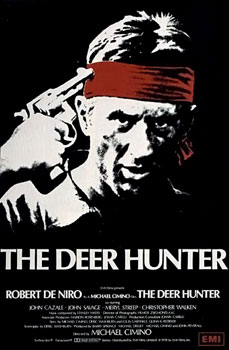
The Deer Hunter: One Of The Worst Oscar Winning Films Ever Made


I love movies. It's pretty obvious, as this blog is dedicated to my thoughts on movies. If there's a movie on TV or Netflix that looks remotely interesting, I'll watch it. I love it when I see a movie that resonates with me, and the ones that resonate with me the most are usually the most highly regarded movies, especially the ones that get Oscar wins/nominations.

However, I will admit that there are movies I try to avoid watching. There are movies that have so many things going against them, that I don't even give them a chance. Prior to seeing it, The Deer Hunter was one of those movies. Despite winning five Oscars, there were so many reasons why I didn't want to see it.

Firstly, it's a three hour long movie from the '70s. The Godfather is a three hour long movie from the '70s, yet it's considered by many as the greatest movie ever made. I think The Godfather is a cinematic masterpiece, so don't assume that I don't like long movies. If anything, I love it when I see a three hour long film that warrants such a long running time. My favorite movie is Magnolia, which is three hours long. I just don't want to see a bad three hour long movie. That amount of time should be reserved for seeing good three hour long movies.

The fact that The Deer Hunter came out in the 70's made it less appealing. Movies were so much slower back then. The first Mad Max film came out in 1979, and despite being only 93 minutes long, it's ridiculously slow paced (and brilliant). The sequel, The Road Warrior, came out two years later in 1981. It's only three minutes longer than the first Mad Max, yet it's ridiculously fast paced (and brilliant too). I assumed that The Deer Hunter was the kind of film that could have been two hours long and still be able to convey the story and emotions without losing any of the emotional impact it had on audiences. So I knew I needed to be really patient to be able to watch The Deer Hunter from start to finish. And that's only one of the reasons why I didn't want to see it.

The second reason why I didn't want to see it was because Mark Kermode - one of my favorite film critics - said it was one of the worst films he ever saw. I don't always agree with Mark Kermode, but he always has a good point. He said Robert De Niro's performance in The Deer Hunter was "In not very good form." There was some bad acting from De Niro in The Deer Hunter (which I blame Michael Cimino for) but for the most part, I thought his performance was great. Obviously his performances in Taxi Driver and The Godfather Part II were superior (because the characters he had to portray in those films were way more interesting), but he still had a great performance in The Deer Hunter. He was incredible in the Russian Roulette scene, which really is one of the greatest movie scenes ever. It's the only scene in The Deer Hunter that's memorable and worth seeing. It's the only scene where I thought Michael Cimino's direction was Oscar worthy. Speaking of which...

Michael Cimino. This fucking guy. He's the main reason why I didn't want to see the film. All you have to do is research the making of Heaven's Gate to see why I wouldn't want to watch any of his movies. The point is, he made one highly regarded film, yet the rest of his films were critical and financial failures. How could a director go from winning two Academy Awards for one film, to making shitty films for the rest of his career? I know why. It's because The Deer Hunter had a politically correct agenda which made it so highly regarded at the time of its release. I'll elaborate on that later.

Despite having so much going against it, I saw it anyway. After all, it's a five time Academy Award winning film, so it must have some redeeming qualities. Even if the film is as bad as I thought it was going to be, at least I have grounds to criticize it because I actually saw it. It has an amazing cast, including the late John Cazale, who's famous for having the greatest acting filmography ever. Some would argue that his acting filmography is perfect, but I disagree.

He was in The Deer Hunter, which is the antithesis of perfect.

NOTE: From this point on, there are spoilers in case you're actually interesting in watching this terrible movie.

I saw the first 15 minutes of it. By that point, I already wanted to stop watching. All those scenes, with the steel working and the scenes at the bar, went on for so much longer than they should have been. The Deer Hunter actually won the Oscar for Best Editing. Why would anyone vote The Deer Hunter as the most well edited film? Whatever. I carried on watching it anyway, because it deserves a chance. It'll probably get better soon. Then I got to the wedding segment...

Look, I respect people's opinions. I recently read an article where Simon Pegg said he has no respect for people that like the Star Wars prequels, which pissed me off. Saying you don't respect a person's opinion just because you disagree with them makes you a fucking douchebag, regardless of what the opinion is on whatever subject. Simon Pegg can go fuck himself. He's a good actor and screenwriter, and I understand that he grew up with the original films and felt heartbroken upon seeing the prequels, but only an asshole could have no respect for an opposing opinion.

With that being said, I thought the wedding segment was fucking horrendous. It could have been told in half the time, without removing any important information. If you actually think the wedding segment in The Deer Hunter is better than the wedding segment in The Godfather, then please explain why. I don't understand how anyone could think it was better, but it won more Oscars than The Godfather, so there must be someone who thinks it's better.

I've seen people defending the overlong first hour of The Deer Hunter, saying "It's all about character development. If it was shorter, the film wouldn't have had the same impact." That's fucking bullshit. There are films that make you care about the characters within the first 5-10 minutes. Look at the wonderful Pixar movie Up. Michael Cimino could make at least 5 three hour long movies that convey the same information as the opening montage in Up, yet he couldn't match the emotional impact. Michael Cimino relies on making five different scenes with information that could have easily been conveyed in one scene. Beating the audience in the head with the same scenes over and over again doesn't make them care more about the characters, nor does it give the characters more depth.

I know The Deer Hunter is a character driven film, yet it fails on that too. I don't mind a slow paced film as long as it's centered on interesting characters. That's why Lost In Translation is one of my favorite movies, because the characters were interesting and relatable. The characters in The Deer Hunter, on the other hand, were assholes. I know why they're assholes: Because they're supposed to chance over the course of the film. The problem is, I didn't like them at all, so I don't care if they change.

At this point, I've dedicated my criticisms to the characters and storytelling, so now I need to criticize the "Oscar worthy" directing. There were moments in the film that didn't work, like the music used when Michael is deer hunting. This is the scene that plays before the Vietnam scenes start. The music didn't match the tone of the scene, which could have broken my suspension of disbelief if I actually liked this movie. Another 'odd' moment was during the Russian Roulette scene between Michael and Nick. It's definitely an intense scene, but the Vietnamese characters have the most over-exaggerated cartoonish evil laughs you'll ever find in an Oscar winning movie. I know I'm nitpicking here, but for a film that has so many flaws, even the best scene has a stupid aspect to it.

The villains of the movie don't even laugh like human beings, because they aren't human beings. This is a racist, one-sided film that portrays the Vietnamese as evil scumbags. The Deer Hunter was made a few years after the end of the Vietnam war, which is why it got so much praise. So many American soldiers had Post Traumatic Stress Disorder from fighting in the Vietnam War, and The Deer Hunter came out while the Vietnam War was at the peak of its relevance. If you made a film about soldiers suffering in the Vietnam War back then, it would have been highly praised, even if the film isn't that great.

I already mentioned that there was some bad acting from Robert De Niro. The scene I'm referring to is the final Russian Roulette scene, when Nick shoots himself in the head. Maybe it's just me, but I thought the acting in this scene was so overdone. It's pretty ironic, because he gives this brilliant piece of acting advice in this video.


I blame Michael Cimino for this. I bet when they were shooting this scene, De Niro gave a far more nuanced performance when reacting to Nick's death. Michael Cimino, being the asshole that he is, probably thought he should have given a more obvious performance, and they shot several takes of this scene. Eventually, De Niro thought: "Fuck it, I'll just be melodramatic. God, I fucking hate Michael Cimino. Never working with this guy again." This is just a theory though, so it probably isn't true. The thing that is true, however, is that nobody wants to work with Michael Cimino.

It's impossible to make an Oscar winning film that has no redeeming qualities. With that being said, The Deer Hunter isn't completely bad: The acting is great (most of the time), the Russian Roulette scene was intense (I don't care if that never really happened in the Vietnam War. The scene was dramatic, intense, and almost perfect in its execution), and I thought The Deer Hunter had a good concept. The concept of characters being arrogant before they fight in the war, then they get traumatized during the war, and they change completely after the war is really interesting. If the film was well executed, I would have loved it. But I didn't.

I should point out that I've only seen the film once. I didn't want to see it again because of how much I hated it the first time, but I'm sure I will see it again. I'll probably post a new review if my opinion has changed on the film.

Who knows. I might love the film the second time I see it.

I doubt it, though.

3/10